


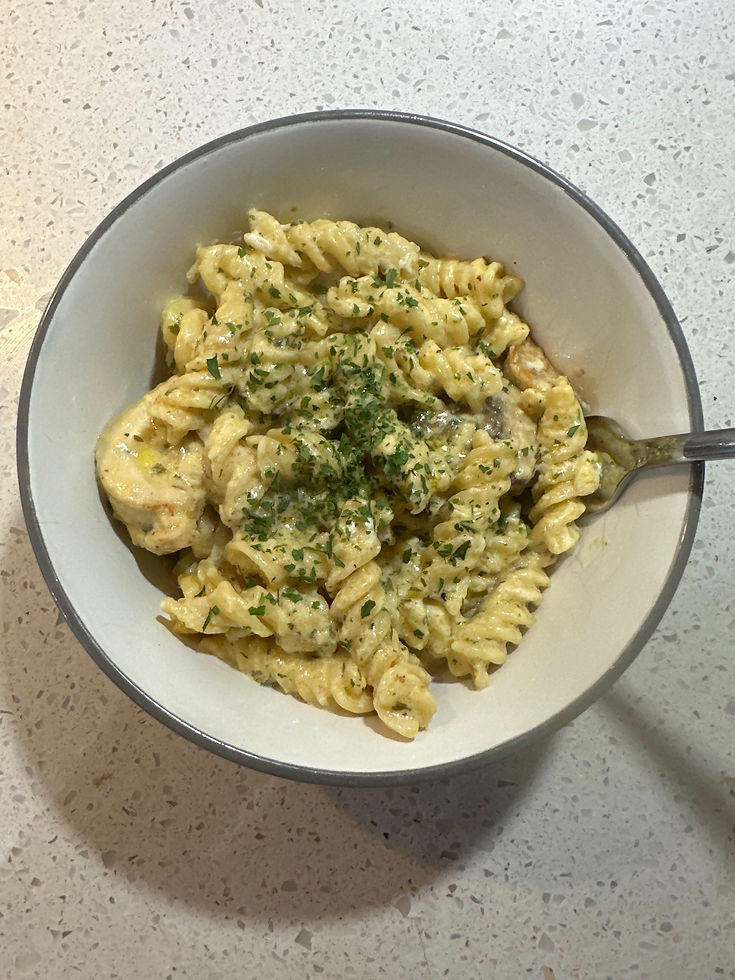
Chicken and Mushroom Fuschilli Pasta


This is the first time that I have fuschilli pasta and it goes well with the chicken and mushroom sauce. Furthermore, chicken and mushroom also go really well together, especially where cream is concerned.
The mushrooms have an earthy flavour. I wanted to blend some of the mushrooms to bring out some of that earthiness and add it to the creamy white sauce but my sister's blender was broken. Oh well maybe next time. The chicken is tender and light in flavour and goes well with the soft pasta. Parsley really goes well with creamy sauces and creates a sweet flavour.
I made this pasta dish when I stayed over my sister's house to babysit my nieces and nephew. This has been their favourite pasta dish to date. I know what I will be making next time, I come to visit.
Prep: 10 mins
Cooking time: 1 hour
Serves:3-4
Ingredients
-1 Pack of Fuschilli
-1 Pack chopped Chicken Breasts
-1 Pack of Mushrooms (chopped)
-2 Pack of double cream
-1 Tsp Butter
-1 Tsp Badin Seasoning
-1 Tsp Garlic seasoning
-2 Tsp Parsley
-Salt and Pepper to taste
-1 Tsp Parsley as a garnish
Instructions
Wash and prep the chicken and mushrooms.
Chop the chicken breasts if you need to.
Boil the fuschilli pasta in water and salt into a saucepan.
Fry the chicken breast in a frying pan with garlic paste and oil.
Add the mushrooms and fry until sautéed.
Drain the pasta and return to the saucepan.
Add butter to the pasta.
Add the cream and garlic paste to the fuschilli pasta.
Add the chicken and mushroom.
Add the parsley to the sauce.
Serve in a bowl and add parsley as a garnish.


The topic of making space for questions in the classroom gives me a few things to think about, especially when the discussion moves beyond general advice. A thoughtful pause can give quieter students time to develop an answer. It also gives the phrase student classroom participation a clearer meaning than a label on its own. I would be interested in a simple example, because it is often the ordinary details that make an idea memorable. What helps a classroom welcome questions that do not have an immediate solution?
Thinking about making particle physics approachable, I find the smaller practical questions more interesting than a quick conclusion. An everyday analogy can help introduce an idea while still leaving room to explain its limits. It gives me a more concrete starting point for thinking about particle physics basics. I would be interested in a simple example, because it is often the ordinary details that make an idea memorable. Which comparisons make particle physics easier to picture without creating misconceptions?
When it comes to connecting school learning with Wasilkow, I would rather understand one useful detail properly than rush through a long list of ideas. A project about nearby places can give students a shared starting point for research. This is why I would approach Wasilkow school community with a specific question rather than a fixed expectation. The part I would like to explore further is what happens when the idea meets a real situation with its own limitations. Which community questions could students investigate through interviews or observation?
Thinking about making collaborative classroom projects work, I find the smaller practical questions more interesting than a quick conclusion. A group task becomes easier to follow when everyone understands their own contribution. It makes me curious about the practical side of classroom project teamwork. The part I would like to explore further is what happens when the idea meets a real situation with its own limitations. How should students share responsibilities without leaving one person to do everything?
What interests me about supporting the move into secondary school is how a broad idea becomes part of an ordinary day. New routines can take time to become familiar even when a student enjoys the lessons. It gives me a more concrete starting point for thinking about secondary school transition. I would probably come back to this question after trying to work through one concrete example rather than deciding immediately. Which parts of the school day need the clearest introduction for new students?